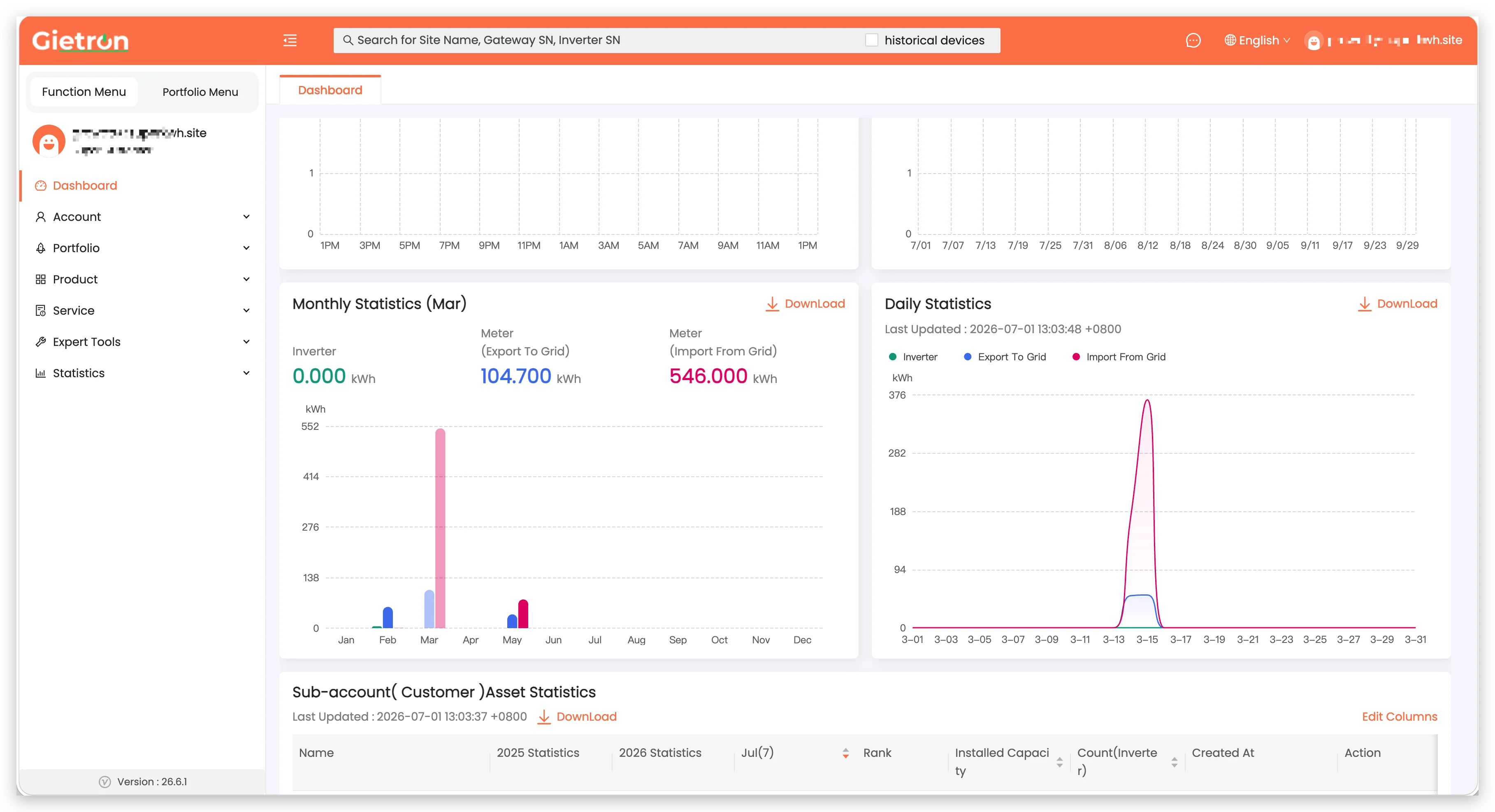
The Synora Cloud Portal is for managing gateways, sites, and inverter fleets across commercial and industrial solar installations, not only Gietron’s products, but also supporting 3rd-party products. It gives installers, EPCs, O&M providers, solution partners, and system owners visibility and control of every site from any browser.
Each deployment lives in an independent account tree. The gateway auto-creates its site after connecting to the internet. Sites can be moved between accounts, and statistics update automatically.
Built for professional energy management at scale, the Synora Cloud Portal supports everything from a single commercial rooftop to a portfolio of campus-scale sites from one unified dashboard.
Dashboard and monitoring
- Overview dashboard: total sites, gateways online, inverters connected, active alerts at a glance
- Site details: energy flow at the Point of Common Coupling (PCC), real-time power export/import, inverter output, meter readings
- Inverter monitoring: real-time status per device, MPPT data, communication health, daisy-chain topology view
- Alert management: filter and export fault and warning data by gateway, inverter, or time period
- Historical data: view, analyze, and export performance records in table format
- Power control status: live view of 0-export thresholds, PPC curtailment targets, and overload conditions per site
At the heart of the dashboard is the Synora-4Q-Flow, a four-quadrant energy view that follows every kilowatt as it moves between solar, grid, load, and storage. Toggle between real-time power (kW) and accumulated energy (kWh) to see not only what the site generates, but where each watt goes — exported, self-consumed, stored, or sent to backup load.
- Revenue reporting: turn Revenue Grade Meter (RGM) data into scheduled revenue reports with step-tariff support, branded invoice templates, and automatic email delivery on a calendar-month or rolling-month cycle.
- Communication diagnostics: an RS485 heat map reveals cabling and hardware issues across the daisy chain at a glance, so installation faults are caught long before they become outages.
- Event-driven automation: build trigger-action rules that watch for alarm codes, offline inverters, or lost gateways, then respond by email, in-app push, or automatic device commands.
- Kiosk and public display: publish a read-only dashboard to a shareable URL for lobby screens, customer portals, or stakeholders — no account required.
Site and device management
- Site list with status filtering and search across the full portfolio.
- Topology mapping: daisy-chain layout, gateway-to-inverter correlation, meter placement, and network diagrams.
- Gateway configuration: firmware updates, cellular data status, communication parameters.
- Advanced diagnostics: Modbus register read/write for technical troubleshooting directly through the portal.
- Multi-Gateway Coordination: Sites using Super TCP can connect one Master Gateway with multiple Co-pilot Gateways, enabling support for up to 128 inverters within a single site.
- Flexible site structure: merge several gateways into one site or split one out — with optional history migration — as projects and ownership evolve.
- Data recycle bin: when gateways or inverters are removed, their historical data is retained for recovery, so assets are never lost by mistake.
- Hot-swap gateway replacement: replace a failed gateway and carry its full history and statistics onto the new hardware with no gap in the timeline.
- Module-level visibility: initialize and monitor Module-Level Power Electronics (MLPE) and rapid-shutdown (RSD) devices, with string-level panel mapping and per-panel performance tracking.
Role-based access for the whole team
The Synora Cloud Portal uses a structured permission system that supports every stakeholder in the commercial solar supply chain.
For customers who have finalized their system design with Gietron, a Customer account is created at the time of product shipment.
O&M Providers can be granted access to manage sites across different Virtual Portals from a single view. Site owners can revoke this authorization at any time. Hardware manufacturers get Cross-Group accounts, letting them provide remote hardware services across all Virtual Portals without seeing unrelated customer data.
Within any account, a Primary Account holder can create Associate Accounts, so several colleagues — or several partner companies — can co-manage the same set of assets without sharing a single login.
Power control and scheduling
Interconnection agreements and utility programs increasingly demand precise control of export and generation. The Synora Cloud Portal puts that control on a schedule, executed locally by the gateway for sub-second response.
- PV Power Throttle: cap generation to a fixed percentage of capacity on a time-of-day schedule, with up to 24 non-overlapping windows per day.
- Zero-export: dynamically curtail the inverter fleet to hold export at zero, within a fixed kW band, or at a specific import target, with three-phase and phase-imbalance support.
- Combined strategies: blend fixed throttling and dynamic zero-export inside the same daily schedule to match complex tariff or interconnection rules.
- Reservation scheduling: override the default plan for a future date or range — for maintenance, testing, or special grid conditions — without disturbing the baseline policy.
Power Import and Capacity Limit
For BESS retrofit applications, the gateway regulates charging power as facility load changes, helping keep the AC busbar within its configured electrical-capacity limit and reducing the need for costly distribution upgrades.
Open platform and integrations
The Synora Cloud Portal is built to fit into a larger energy stack, not to lock data inside it. Every account can expose its sites and hardware to third-party platforms through several integration paths.
- API channel: authorized read and write access to application data and hardware, grounded in the portal’s own account and asset model.
- CCI channel: hardware-level integration by device SN and ID-token, ideal when the third party brings its own account system.
- Raw Data Forwarding (RDF): one-way push of fixed-format inverter data to an external HTTP or MQTT endpoint.
- Modbus TCP and SCADA: the gateway speaks Modbus TCP natively, with four SCADA coexistence modes and virtual register maps (including the Duke Energy profile) for utility-grade interconnections.